Midhun P M — Case studyNightWatch
- Next.js
- React
- TypeScript
- Three.js
- FastAPI
- Python
- OpenAI
- SQLite
- Dokploy
🥈 Second Prize · Codex Community Hackathon, Calicut
The problem
I run my own infrastructure. When something breaks, the explanation is usually scattered across deployment panels, containers, metrics, domains, and logs. A service can exist in Dokploy, have a running container, and still return an error through its public route.
I wanted one place to inspect that evidence and work through the next action. Giving an agent infrastructure access also meant making its decisions reviewable.
What I built
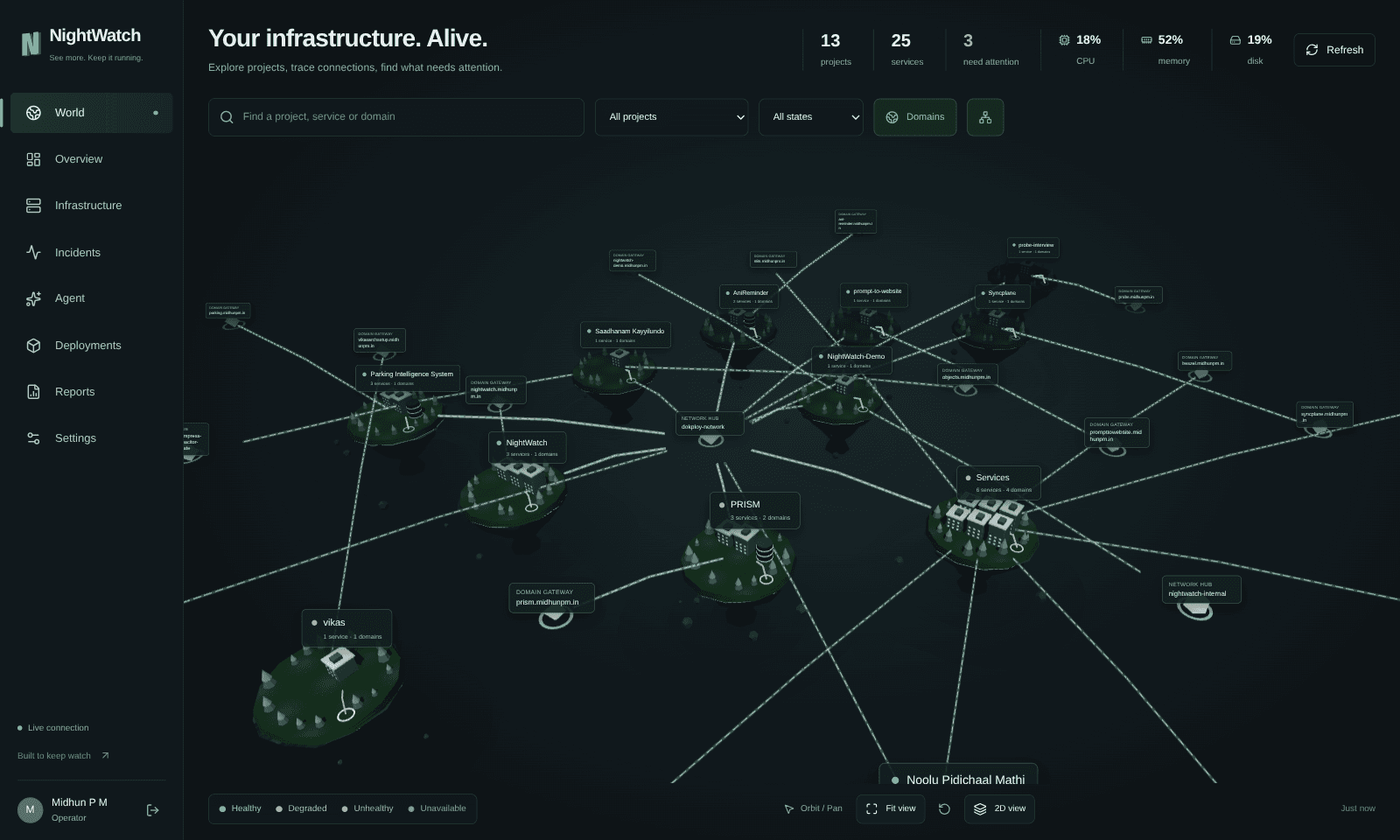
NightWatch is an agentic infrastructure operations console. It combines Dokploy inventory, Docker identity, Beszel telemetry, routes, and HTTP probes into one live infrastructure model. The interface includes a 3D world, a 2D operations view, incident timelines, persistent agent conversations, and deployment workflows.
I built it as a solo project for the Codex Community Hackathon, Calicut, at TinkerSpace on 19–20 September 2026. It won 🥈 Second Prize, with 3 months of ChatGPT Pro and $500 in OpenAI API credits. I have continued refining the implementation since the event.
The operator can ask about a service, investigate an incident, or prepare a deployment in plain language. The agent uses typed tools to gather evidence and cite its findings. A deployment request becomes a concrete plan containing the repository, branch, Dockerfile, port, domain, and target.
Changes require approval of the exact plan version. Before execution, NightWatch reads the target again and rejects a plan if relevant state has changed. It preserves the result for later inspection.
Architecture and decisions
Next.js and Three.js for the interface. React Three Fiber renders project islands, service health, domain gateways, and connections. A 2D view makes the same infrastructure easier to read without spatial navigation. Stable graph placement keeps observation refreshes from rearranging the world.
FastAPI for the control plane. The authenticated Next.js gateway proxies allowlisted routes. Integration credentials stay on the server. Python services own observation, reconciliation, incident records, plans, approvals, and execution.
SQLite for durable history. Async SQLAlchemy and Alembic preserve conversations, evidence, hypotheses, timeline events, and workflow state. A private operator console needs that history when a remote operation only partially succeeds.
Bounded model work. Codex app-server powers operator chat. A separate OpenAI investigator gathers evidence within tool, output, and time limits. Continuous monitoring runs independently, so an observation cycle does not automatically become a paid model investigation.
The hard part
Matching Dokploy resources to Docker replicas and Beszel samples required explicit identity reconciliation. Missing or stale telemetry remains visible as unavailable evidence.
Dokploy's start operation also behaved differently for idle applications. NightWatch now checks lifecycle state and uses deployment when an approved start needs to create the service.
The result still needs careful wording. General operations verify API acceptance and target readback; public application health remains separate evidence. Shared network membership also does not prove an application dependency.
Explore NightWatch
The live console controls real infrastructure and requires a private operator passphrase. The public narrated demo shows the workflow without requiring console access.